CASE STUDY
AI Search for Pipeline Management
Making complex recruiting workflows searchable with natural language.
Recruiters manage large candidate pipelines through combinations of structured filters, statuses, activities, and recruiting attributes. I designed an AI-powered search experience that lets recruiters describe what they need in natural language, translates their intent into structured filters, and keeps the result transparent and editable.

ROLE
Lead Product Designer
Time
2026
SCOPE
Product strategy · AI interaction design · Prototyping with AI · User research
CUSTOMERS
Product · Engineering · Recruiting Operations
Projected impact
AI Search was designed to reduce the effort required to find the right candidates in complex recruiting pipelines. By translating natural-language intent into structured filters, the experience reduces manual filter construction while unlocking pipeline data that recruiters previously could not search directly.
~5.1K hrs / year
Estimated annual time savings
~$220K / year
Estimated annual operational value
~4K
Recruiting users supported
700K
Filter sessions annually
25%
Less time constructing filter queries
1. The problem

Powerful recruiting data, but difficult to query
Recruiting Pipeline Management gives recruiters access to rich talent data, but finding a specific group of talents can require building combinations of filters across multiple dimensions.
The challenge was not a lack of data. It was the effort required to translate a recruiter’s intent into the system’s filtering language.
A recruiter might know exactly what they want:
“Show me candidates waiting for feedback after an onsite interview.”
But getting there requires knowing which filters to use, how they work together, and how the underlying recruiting workflow is represented in the system.

2. The solution
2.1 Translate natural-language intent into structured filters
Search the way recruiters think
Instead of requiring recruiters to manually construct complex filters, I designed an experience where they can describe the candidates they need in natural language.
AI interprets the request, translates it into structured recruiting filters, and returns the corresponding candidates.


Crucially, the AI does not operate as a black box. Recruiters can see what the system understood, inspect the generated filters, modify them, and remain in control of the final search.
Ask naturally → AI interprets intent → Filters become visible → Recruiter reviews or edits → Results update
2.2 Keep AI transparent and editable
Making AI understandable and reversible
For an operational recruiting tool, getting a plausible answer was not enough. Recruiters needed to understand what the AI had done and be able to correct it.
The final model keeps AI-generated structure visible and editable, allowing recruiters to move fluidly between natural language and manual refinement.

Designing responses around the type of failure
AI failures are not all the same. I defined response patterns for partial understanding, unsupported requests, unclear intent, and valid searches with no matching results.
Rather than collapsing these scenarios into a generic error state, the system communicates what it understood, preserves valid results when possible, and guides recruiters toward a recoverable next step.

2.3 Resolve ambiguity before continuing
Recruiters do not always describe candidates using the same terminology as the underlying system, and recruiting data itself can be ambiguous. A query may reference a person, job, requisition ID, or multiple entities with similar names.
Rather than making an invisible assumption, I designed the search experience to surface ambiguity and let recruiters resolve it before continuing.
The interaction adapts to the level of certainty. When the system identifies a clear match, it resolves the entity directly. When a query maps to multiple entity types or possible matches, the experience surfaces those options for recruiter confirmation.
Clear entity match

Cross-entity ambiguity

Multiple possible matches

2.4 Future direction · From AI Search to AI Assistant
AI Search establishes an interaction model where recruiters can express intent naturally, understand how the system interpreted it, and stay in control.
This concept explores how the same model could extend beyond search into broader recruiting workflows through a contextual AI Assistant.
(Future concept · In design)


3. Why this approach works
Natural language without sacrificing control
The experience combines the flexibility of conversational AI with the predictability of structured enterprise search.
Lower the effort to start
Recruiters no longer need to know the exact filter structure before searching. They can begin with the recruiting intent they already have in mind.
Make AI reasoning visible
Generated filters expose how the system interpreted the request instead of hiding the logic behind an AI response.
Keep recruiters in control
Every generated filter remains editable. Recruiters can refine the AI’s interpretation using familiar controls rather than restarting the search.
Bridge AI and existing workflows
Natural language becomes a new entry point into the existing recruiting system rather than replacing the structured tools recruiters already understand.
4. Validated with recruiters
Research artifacts from the study
Recruiters understood the model and saw immediate value
I validated the interaction model with recruiters using realistic recruiting queries and workflows. Testing confirmed that natural-language search could reduce the effort required to construct complex filters while keeping users in control of the generated criteria.
(Research artifacts from the study)
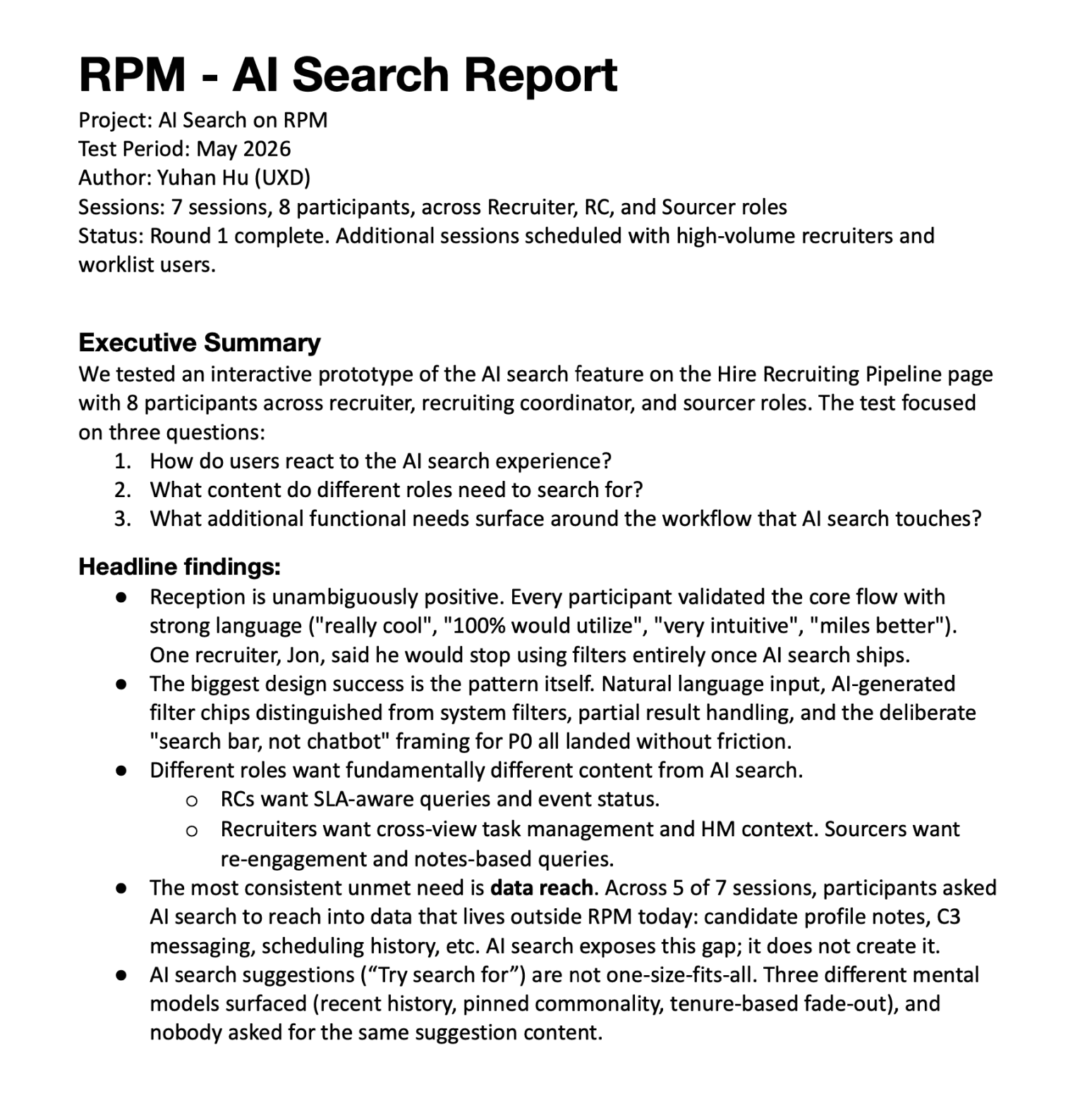

The interaction model worked
8 / 8
Participants responded positively to the natural-language search experience.
8 / 8
Understood the distinction between AI-generated and system filters without explanation.
8 / 8
Validated partial-result handling as the right failure pattern.
The research validated natural-language search as a credible alternative to complex manual filtering for complex recruiting queries.
User feedback
“I don't see a world where if we bring this feature in that I would use filters.”
Senior Recruiter @ Amazon
Efficiency
Filter construction time · Workaround reduction
AI quality
Filter mapping accuracy · Filter removal rate · Re-query rate
New capability unlocked
Dynamic filter usage · Previously unfilterable fields
Adoption
Weekly usage · Retention · Queries per session
Performance
Query latency · Fallback rate
Customer satisfaction
Recruiter CSAT
7. Outcome
Launched in late Q3
The AI Search experience launched successfully in late Q3 as part of Recruiting Pipeline Management.
We are now monitoring post-launch performance to understand adoption, search behavior, and how effectively the experience helps recruiters reach relevant candidate sets.
Designing the interaction model
1. Mapping recruiter language to system logic
Recruiters describe the same underlying workflow in many different ways. I explored realistic recruiting queries and mapped them to the existing filter model to understand how natural-language intent could translate into structured system logic.
This helped identify where terminology aligned cleanly, where multiple interpretations were possible, and where the experience would need clarification.
Recruiter language → System logic
“My external candidates under HM @marba”
Hiring manager entity + external candidate scope
2. Defining the interaction model
I translated these language patterns and system constraints into a clear interaction model: recruiters express intent naturally, AI interprets that intent into structured filters, and recruiters can review and refine the result before applying it to the pipeline.
Natural-language intent
“Candidates with scheduled assessments and interviews where@marba is the hiring manager”
AI interpretation
Hiring manager: Marcus Bar
Candidate activity intent: Scheduled assessments + scheduled interviews
Generated filters
Hiring Manager = Marcus Bar
Assessment status = Scheduled
Interview status = Scheduled
Recruiter review and refinement
Pipeline results
This created a bridge between a new AI interaction and the existing mental model of pipeline filtering.
Takeaway:
AI Search established an interaction model where recruiters can express intent naturally, understand how AI interpreted it, and stay in control. The AI Assistant explores how that model could extend into broader recruiting workflows over time.
Research participants are identified by role rather than name. Product screens are recreated with sample data.